N PLUS INFINITY TIMES TWO: Impressions and interview
"More 'friendgem', less 'friendslop'"

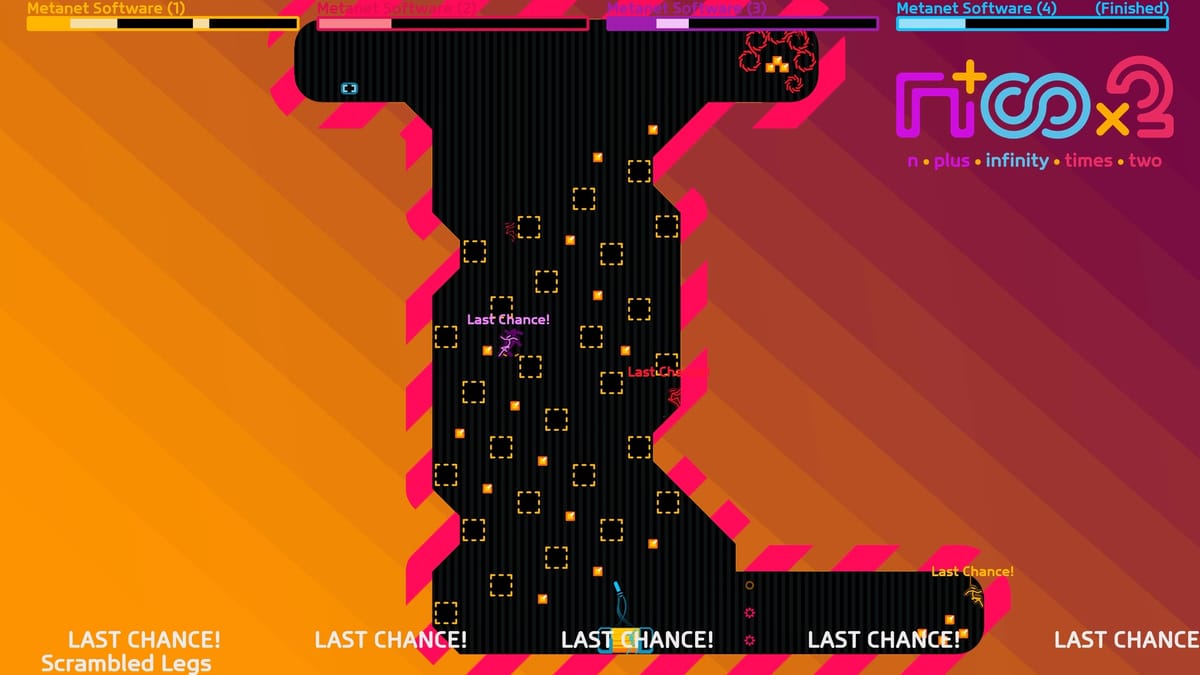
When I played N PLUS INFINITY TIMES TWO at Gamescom in August, I had this niggling feeling that I'd played another entry in the series before. It wasn't until friends reminded me on my return that I used to play N, the original game in the series, way back in 2005/2006.
The series, developed by Metanet Software, has a simple concept: you're a stickman who needs to get from one point to another, avoiding dangerous traps and projectiles. I played the original Flash game so much in the mid-2000s, but I admittedly forgot about it. Fast-forward to August 2026, and I'm finding myself playing the latest game, the multiplayer-focused latest entry, N PLUS INFINITY TIMES TWO at Gamescom, and enjoying it a lot.
Earlier this month, I spoke to Mare Sheppard - Creative Director, and Raigan Burns - Technical Director, as well as both being Level Designers and Game Designers on N PLUS INFINITY TIMES TWO, about how it came to be, whether we'll see earlier entries on mobile devices, and more.
To Infinity, TIMES TWO
You said you were both done with the N series after N++ - did the lack of online multiplayer eventually feel like unfinished business?
Mare Sheppard: Yep, that was definitely the grain of sand that formed the pearl of this new game. We had made N++ with a focus on the hardcore single-player platforming, but it also included a bit of local multiplayer – because we loved how Co-op turned out in N+, so we wanted to continue down that road. Plus, it was in the air in the 20-teens (we're fans of Nidhogg, Towerfall, etc.).
Raigan Burns: After N++ was released, we were really pleasantly surprised with how many people were engaging with the local multiplayer – there were YouTuber families playing co-op, Twitch streamers playing Race Mode, etc. There was even an in-person N++ Race Mode tournament in 2021, where 8 fans flew into Portland to spend the weekend competing to see who was best! It was so fun to watch.
Sheppard: This really made us recognise that the multiplayer modes were arguably even more fun than the single-player, even though we'd originally conceived the game as a purely single-player experience. The ninja's controls and physics have surprising flexibility, and we discovered that changing the context around movement and tweaking the goals players are aiming toward opened many exciting new doors for design. We were excited to explore those new spaces further and see where we could go. So that became the focus of the new game.
Did anyone warn you both about how N PLUS INFINITY TIMES TWO could be a search term nightmare for new players?
Burns: Haha, that's the story of our lives! We already knew from our experience with N+ and N++ that we needed English words in the title or else no one would be able to find it. The working title for most of development was actually "Way Of The Ninjas"; the thought behind that was that we were designing this new game as a stand-alone experience that worked for new players as much as fans, and using "N" in the title felt a bit too much like "Godfather III" – we worried it would scare away anyone who didn't know what N was or who had seen previous titles and decided a hardcore single-player experience wasn't for them.
Sheppard: We wanted to encourage new players to give it a try since we think N PLUS INFINITY TIMES TWO stands apart from the previous games in the series: it's got much more of an upbeat party feel, and is all about having a fun and fluid experience playing with others, so we really wanted the name to underline how much of a departure this one is from the previous iterations.
Burns: Eventually, we recognised that in this day and age of massive oversaturation, fans might miss the game if it didn't include "N" in the title. So we decided on a name that we hope captures the spirit of this iteration: silly, light-hearted, fun, but also suggesting a more monumental, substantial experience. More "friendgem", less "friendslop"..!
Microsoft made online multiplayer mandatory on XBLA, something which forced you to consider multiplayer in 2008. Now it’s the main focus of Times Two. Is this the game N+ should have been?
Sheppard: Sort of – our vision for N++ was "what if we return to the original N, but redo it from scratch using the decade+ of experience we've gained since we made the original version?" So, N++ was our attempt to make the definitive hardcore single-player platformer. N PLUS INFINITY TIMES TWO is the same idea, except applied to N+: it's been 18 years since that game came out, and we are a lot better at making games now, so we thought: let's try to make the best possible version of that same basic vision – the definitive multi-game-mode online multiplayer momentum platforming experience.
Burns: It's not so much "should have been" – we think N+ is the best thing we could have made at the time, with the budget and schedule we had, that early in our careers. Rather, it's more about returning to that same basic space and reevaluating everything from a new perspective, with two decades of additional experience and learning behind us.
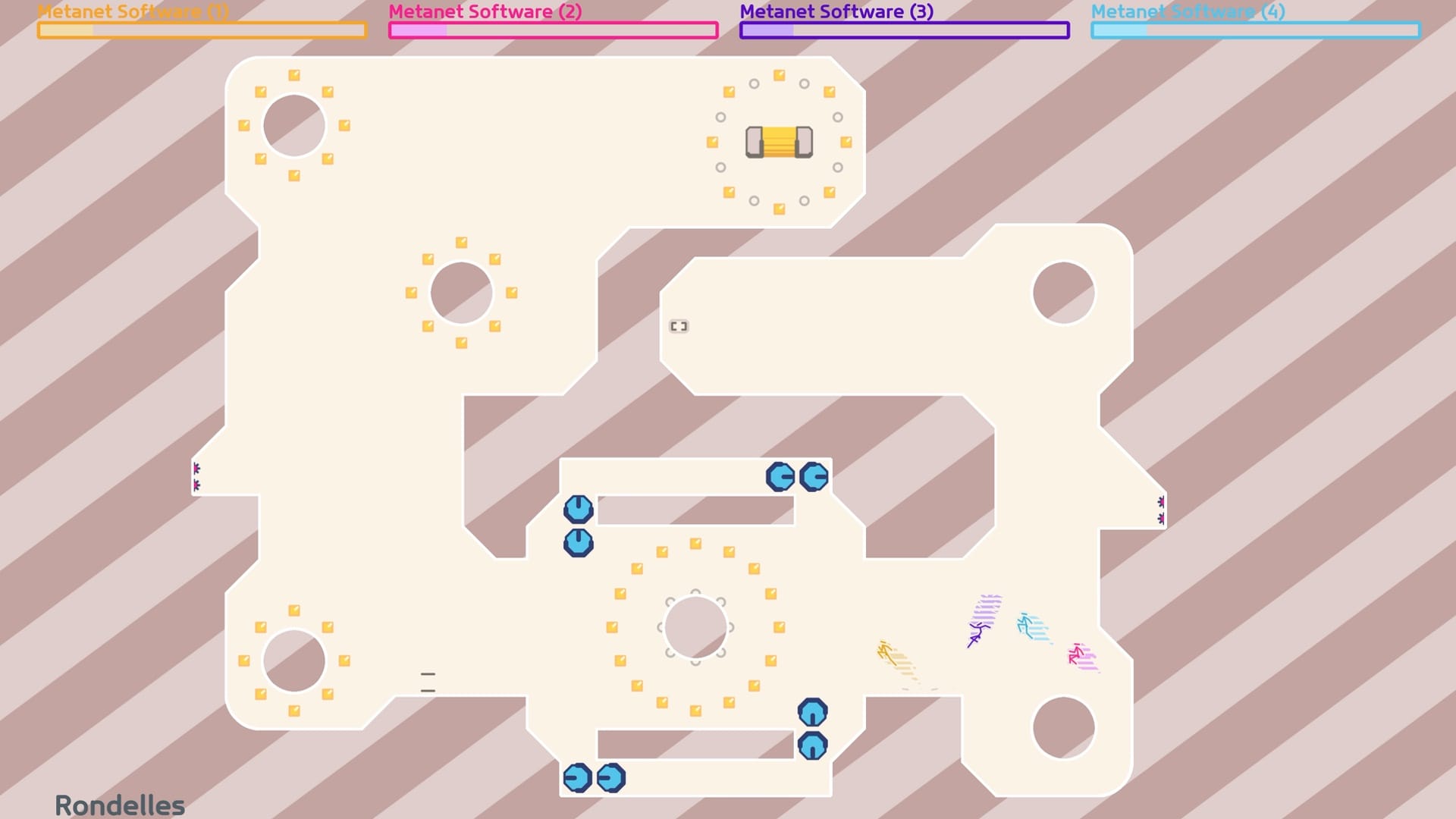
Having played TIMES TWO at Gamescom, I was struck by the art style - was that deliberate to let players know that this was a fresh new entry in the series?
Burns: Yeah, we definitely wanted to push the envelope a bit more compared to N++ and demonstrate the differences between this game and previous games in the series. N++ was much more of a focused, intense, serious experience – the minimal, flat graphics worked perfectly to support players as they engaged with the incredibly hardcore challenge. N++'s graphics were designed with functionality in mind.
Sheppard: Since TIMES TWO has much more of a party vibe, it's less about difficulty and leans further into playfulness, and we thought the graphics should express that too. Plus, it's fun to stretch out and explore something a bit wilder and more adventurous after the careful, self-restrained presentation of N++. We're having fun navigating the tension between the series' minimalist core and the opportunities for a more maximalist approach. It's another design challenge that we really relish!
It’s being pitched as a couch party game, which is how I felt when I played it. But the series is known for its addictive brutality - how do you make it work for a friend who’s never played an N game?
Sheppard: For one thing, the level design this time is definitely much more focused on variety and delight rather than a super hardcore challenge – at this point, there is a whole new generation of players for whom this might be their entry into the N series, so we're trying to make sure that there is a nice gradual difficulty ramp and a slightly less hardcore attitude in general. (Our main reference/inspiration for this is the transition Nintendo made from Super Mario Bros. 3 – a very hardcore game made for Mario fanatics – to Super Mario World, where they were able to craft something that satisfied hardcore fans while also being friendly enough for first-time Mario players.)
Sheppard: By shifting from single-player to multiplayer, the game's focus shifted from player vs level to player vs player. This means that the levels themselves don't need to carry the conversation as much, and they can be a bit less brutal while still being very engaging – because the challenge is now coming from your opponents rather than the level design. The levels support the dynamism between players, which is the main fun of the game.
Burns: N++ was definitely very much about the try-die-repeat loop, and while that is great, going into TIMES TWO, we wanted to try some new things, especially since we personally don't feel like we could substantially improve on N++ in terms of hardcore single-player platforming: we think we did a good job of more or less exhausting that general direction. Plus, we recognise that the basic masocore game loop isn't quite as exciting and fresh now as it was 20 years ago – or even ten years ago, when we made N++. So with TIMES TWO, we're sort of turning perpendicular to that axis and exploring a whole new dimension of possibilities, using the same basic momentum-platforming core in some new contexts.
Sheppard: Yeah, so most of the multiplayer modes in TIMES TWO go in a different direction than try-die-repeat, with game loops that are designed such that it's impossible to get stuck on a level or be in a situation where you're banging your head against a wall again and again for hours. Instead, after a few minutes of frantic running and jumping, there will be winners and losers, and you'll move on to the next level. (The original single-player and co-op modes will still be there, so you can keep the more intense experience if you want, but it's more of a side dish compared to the new modes, which are more playful and less serious.)
Burns: Another thing is that some of the modes are team-based (Co-op and Team Tag), so fans of the series can introduce it to less-experienced friends and help carry them if needed.
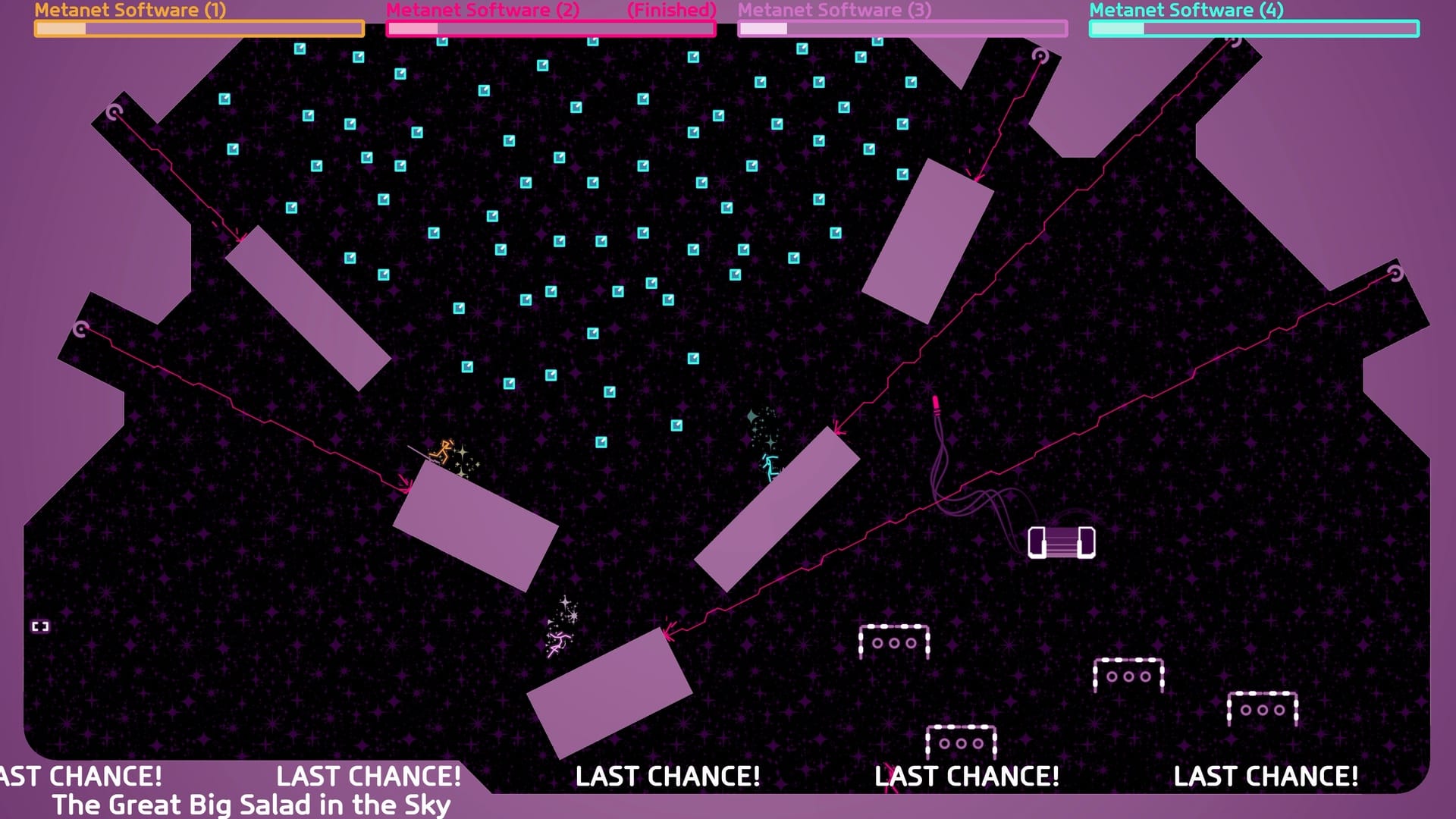
Dozens of players have 100%-ed N++ and received a handmade certificate - will this tradition carry on with Times Two?
Sheppard: We're hoping to do something similar, but this is another good example of how this new game is going in a different direction than N++. It was very much about the challenge of "completing" it, and this was such an accomplishment that we wanted to do something special to recognise any player who gave the game that much of their time and attention. So far, there have been 54 100%ers! We famously predicted zero in the launch trailer. It's delightful to have been wrong!
Burns: TIMES TWO is designed to be a lot more open-ended – there's no such thing as "completing" the game, any more than you could "complete" Counter-Strike or Rocket League. So, we don't know exactly what form special recognition for players will take yet, but there will definitely be something. We would absolutely love to run tournaments or otherwise reward players at the top of the rankings in the competitive online modes.
The 2025 review post mentioned setbacks on the new game - can you say what these were? Has 2026 turned into a better year at least?
Burns: Unfortunately, we're not at liberty to discuss specifics about that yet. We can say that things are definitely on an upswing, and our trajectory through 2026 has been very rewarding and encouraging: progress on the game itself is going well, and we hope to be able to talk more openly soon, in the context of a post-mortem, for example, but unfortunately, we're not there quite yet.
The N games have always seemed like a perfect fit for iOS and Android devices - could we ever see an N++ port land on these handsets someday?
Burns: This is a comment we get a lot, but unfortunately, neither of us really sees the experience translating very well to a touchscreen. We're big fans of high-quality boutique mobile games – Michael Brough, Kamibox, and grapefrukt are some of our favourite game developers – but we feel very strongly that great mobile games need to be designed for that specific platform and form-factor, and the N series is something that we think absolutely needs physical controls in order to work.
It's so precise that virtual buttons or other touch controls would undermine the game's central premise. And we know from experience that there's a delicate balance between frustration and satisfaction, which sloppy controls would absolutely ruin.
Sheppard: Not to mention, while the graphics in N++ might appear quite simple, under the hood, there is some advanced vector-rendering tech that's going into making everything look as smooth as it does, and it's not clear that it would be very performant on a relatively low-powered GPU.
When we make games, we consider all the aspects we can and try to take the utmost care to craft the best play experience possible because we believe that putting a ton of love and consideration into all the details is part of what makes our games special, and gives them depth and personality and nuance. For this series, we need the power and physical buttons of PCs/consoles to really make things sing.
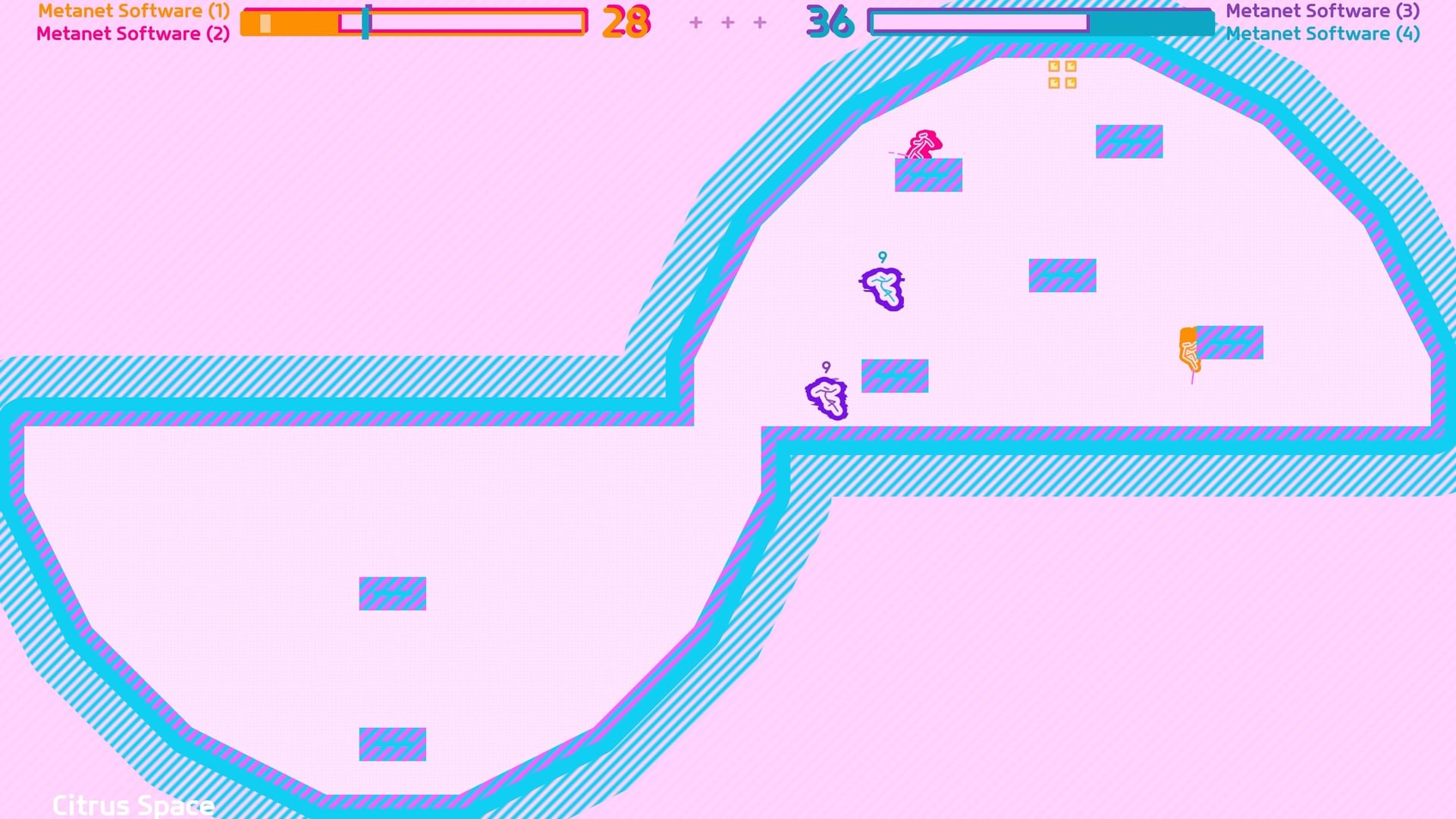
With AI being a huge focus in game development, where do you both stand on it - and has it been used in TIMES TWO?
Sheppard: We make games because we enjoy making games; we enjoy the process, and the process is what gives our work value. We love to pour our interests and expertise into our work and delight over the small details – this is the fun part of making a game! Why would we want to outsource the fun part?? This recent post from Maddie Thorson encapsulates our perspective really well.
Burns: We have never used an "AI" product, recreationally or professionally, and we plan to continue never using them. We are adamantly opposed to this technology, on basic moral/ethical grounds: it's fundamentally built on wholesale theft and lack of consent; this is a "fruit of the poisonous tree" situation, which in a sane society should be a complete nonstarter, and grounds for these companies to be nationalised if not simply dissolved and prosecuted.
Sheppard: Beyond that, it has very obvious and severely negative externalities: it's helping billionaire oligarchs amass even more power and control over the rest of humanity; the economic disaster when the investment bubble inevitably bursts will be globally devastating; it seems to have a deleterious effect on human cognition; not to mention the more mundane but extremely important problems such as noise/air/water pollution and other negative environmental impacts.
N has come a long way since its Flash days - how does it feel to be working on a new entry for players who have been there since the start?
Sheppard: It's very exciting for us – for a while we worried that we should be working on a multitude of diverse games, like it was some sort of deficiency to specialise in one series – especially since we have loads of other ideas we're interested in pursuing.
We've certainly prototyped many other games, but so far none of them has been as viscerally fun to play as the N series, and since we keep having great ideas for the series that we're genuinely excited to try, we have realised that we're really proud of what we've been able to accomplish and don't need to pressure ourselves to do something else as long as this keeps bringing us joy and satisfaction.
We couldn't be happier with our history. It's been incredible to see so many people share our love of this series over the years, and to meet so many amazing players. And to meet other inspiring game developers – we've loved watching what's been made in this space over the years, and love being able to keep contributing to such a beautiful and exciting area of game development.
Burns: One thing that's new for us is that this is the first time we've been developing a game in the "open" – previously, we had worked in the old model where you sort of make the game privately, maybe take it to a few trade shows, and then release it. This time we've already shown it a few times (as you know), we're doing playtest streams with our Discord community, and we will be starting a beta test later this year – it feels a bit scary but also exciting to get feedback in real time, as opposed to sort of being cooped up in the recording studio making the album without anyone hearing it.
Sheppard: When we made N, we set out to make something that had not been made before, but which we really wanted to play. That's still our driving motivation, and we hope TIMES TWO will appeal to players old and new. Since we enjoy playing it, we're optimistic that players will too, and so far, playtesting has confirmed that. So now, we're even more excited to get TIMES TWO out there; we think people will really love it, and we can't wait to watch them play together.
My thanks to Mare Sheppard and Raigan Burns for chatting with me. N PLUS INFINITY TIMES TWO is out on PC in 2027.